
You hear a certain tone of voice, receive an unexpected message, or sense someone's disappointment. Before you've had a chance to think about what happened, your chest tightens. Your stomach drops. Your heart starts racing. Perhaps you feel angry, anxious, frozen, or suddenly disconnected. A few seconds later, your thinking mind catches up.
Why am I reacting this way? I know I'm safe. I know this isn't the past.
If you've experienced childhood, relational, or complex trauma, this disconnect between what you know and what your body feels may be familiar. The explanation lies partly in how the brain and nervous system learn to recognize and respond to potential threats. And understanding that process can help you begin responding differently.
Why Does the Body React Before the Thinking Mind?
Your brain is constantly interpreting information from your surroundings and your body, often before you consciously recognize what you're experiencing.
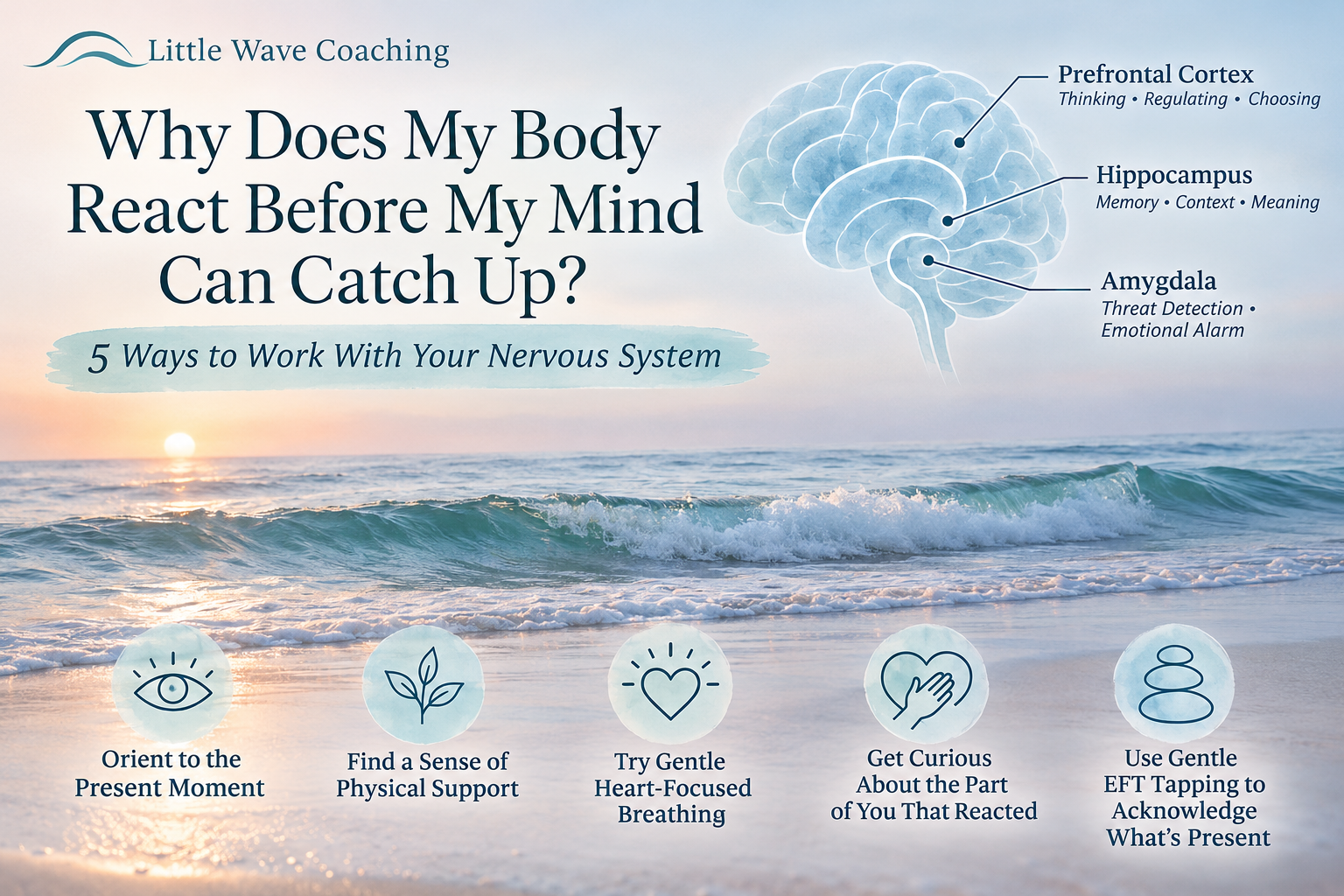
Several interconnected brain regions help make this possible:
The amygdala participates in detecting emotionally significant information, including potential threats.
The hippocampus helps connect experiences with memories and context, including whether something resembles a previous event.
The prefrontal cortex supports attention, interpretation, decision-making, and emotional regulation.
The autonomic nervous system helps coordinate physical responses, influencing heart rate, breathing, muscle tension, and other bodily functions.
These systems work together, not independently or in a simple sequence. When something resembles a previous threatening experience, learned associations may activate a protective response before you've consciously made sense of the situation. Your heart may race. Your muscles may brace. You might feel an urge to escape, defend yourself, appease someone, or withdraw. This is why knowing you're safe and feeling safe aren't always the same experience. Research on threat processing helps explain how learned associations can influence automatic responses, even when our current circumstances are different from the original experience.
Why Trauma Can Make These Reactions More Persistent
Our nervous systems learn from experience. If you grew up in an unpredictable environment, for example, you may have become highly attuned to subtle changes in facial expressions, tone of voice, or mood. Perhaps noticing those changes once helped you anticipate conflict or protect yourself. Years later, a similar cue might still produce a strong bodily reaction, even when the current situation is relatively safe. For some people, these reactions look like anxiety or hypervigilance. For others, they appear as numbness, withdrawal, difficulty speaking, or a sudden sense of disconnection. They aren't necessarily conscious choices. And they don't automatically mean that something dangerous is happening now. The nervous system can respond to reminders of past threats as well as threats in the present. This helps explain why someone can have tremendous insight into their history, understand their triggers, and still experience powerful physical responses. If this sounds familiar, you may also appreciate my article Why Am I Still Triggered After Therapy?
5 Gentle Ways to Work With Your Nervous System
Understanding your nervous system is valuable, but sometimes understanding alone doesn't change what you're experiencing in the moment. These five practices offer simple ways to introduce awareness, support regulation, and create a little more room between a trigger and your response. You don't need to practice all five. Start with whichever feels most comfortable and supportive.
1. Orient to the Present Moment
When your body reacts to something familiar from the past, gently reconnecting with your present surroundings may help you distinguish then from now.
Try this:
Slowly look around the room.
Notice three objects, colors, or shapes.
Let your eyes rest on something neutral or pleasant.
Remind yourself where you are and what is happening right now.
You might quietly say:
I'm here, in this room, in this moment. There's no need to force yourself to feel calm. The intention is simply to offer your system additional information about your current environment.
2. Find a Sense of Physical Support
When we're overwhelmed, we sometimes lose awareness of the physical support beneath us.
Gently noticing contact with a stable surface can help anchor attention in the present.
Try this:
Feel your feet resting on the floor.
Notice the chair supporting your back.
Gently press your feet downward, then release.
Pay attention to any small change in sensation.
If turning inward feels uncomfortable, keep your eyes open and focus on the contact between your hands and a nearby surface instead. The goal isn't to eliminate difficult sensations. It's to explore whether your body can notice support alongside them.
3. Experiment With Gentle Heart-Focused Breathing
During stress, breathing often becomes faster or shallower.
Slowing the breath comfortably can help support the body's relaxation response.
Try this:
Bring your attention to the area around your heart or chest area, if comfortable.
Breathe at a gentle, unforced rhythm.
Imagine the breath moving smoothly in and out through that area.
Continue for about a minute, without trying to achieve a particular feeling.
You may also bring to mind something that evokes appreciation or warmth, provided that feels accessible. This is similar to a foundational practice used in HeartMath® heart-focused breathing and coherence training. Please be aware that breathing exercises aren't comfortable for everyone. If focusing on your breath makes you dizzy, anxious, or more disconnected, stop and return to something external, such as looking around the room.
4. Get Curious About the Part of You That Reacted
Sometimes a reaction makes more sense when we approach it with curiosity rather than criticism.
Instead of asking, Why am I still doing this?, you might ask: Is there a part of me trying to protect me right now?
Try this:
Notice the emotion that's present.
Gently acknowledge it: A part of me feels frightened, or A part of me wants to run away.
Ask what that part might be concerned about or trying to protect you from.
Pause and listen in for a compassionate response without trying to change the feeling immediately.
You might say: I can understand why this feels threatening. I'm listening.
This is one way of introducing the principles of somatic parts work: recognizing protective responses while developing a more compassionate relationship with them. You don't have to investigate old memories or revisit painful experiences to begin practicing this kind of self-connection.
5. Use Gentle EFT Tapping to Acknowledge What's Present
Emotional Freedom Techniques (EFT), often called tapping, combine light tapping on specific acupressure points with focused attention on emotions, thoughts, or bodily sensations. Some people find this combination helpful for settling themselves and approaching difficult feelings with greater awareness.
Try this:
Notice one feeling or sensation that's present.
Gently tap on the side of either hand.
Say something simple and compassionate, such as:
Even though I'm feeling activated right now, I can give myself a moment.
Continue tapping gently for 30–60 seconds.
Pause afterward and notice whether anything has changed, without expecting a particular outcome.
This brief exercise is a self-care introduction, not a substitute for guided trauma processing. More complex or distressing experiences may be better explored with appropriately trained support.
You can learn more about Clinical EFT® and how I use tapping in somatic trauma recovery coaching.
What If Trauma and Chronic Pain or Illness Overlap?
Many people I work with are navigating not only trauma-related overwhelm but also chronic pain, persistent physical symptoms, or complex health conditions. This intersection deserves particular care. The nervous system participates in both our stress responses and the processing of physical sensations, including pain. Stress and heightened threat sensitivity can influence muscle tension, pain perception, fatigue, and our capacity to cope with physical discomfort. But that does not mean chronic illness is caused by trauma, that physical symptoms are imaginary, or that medical evaluation is unnecessary. People can experience genuine medical conditions and changes in nervous system sensitivity at the same time. In my work, gentle regulation practices, somatic awareness, and carefully paced body-based support may complement the medical and psychological care someone is already receiving. The goal is not to explain away symptoms. It's to support the person experiencing them.
Why One Practice May Be More Helpful Than Five
When you're feeling triggered, it's tempting to try everything you've learned. But nervous system support doesn't have to become another demanding task. Sometimes thirty seconds of orienting, a compassionate acknowledgment, or a few gentle breaths are enough to create a small shift. At other times, no immediate shift occurs—and that doesn't mean you've done anything wrong. What feels supportive can change from one day to the next. This is an important principle behind Somatic Stacking™, my personalized approach to somatic trauma recovery coaching. Rather than asking someone to use every available tool, I thoughtfully combine and sequence practices according to their needs, capacity, and responses. A session might begin with gentle regulation, move into somatic parts work or Clinical EFT when appropriate, and close with integration. The emphasis is on responsiveness and pacing—not intensity or performance. For more on this distinction, read Why “Doing All the Tools” Slows Down Trauma Healing.
When Somatic Coaching Complements Psychotherapy
Many of the people who seek my support have already spent considerable time in psychotherapy. They understand their history. They can identify their patterns. They've developed meaningful insight into why they respond as they do. Yet certain emotional and physiological reactions still feel difficult to shift. Others are actively engaged in psychotherapy and want additional body-based support as they work through trauma or chronic health challenges. Somatic trauma recovery coaching can offer complementary practices focused on nervous system awareness, self-regulation, embodied self-connection, and applying these skills in everyday life. With a client's permission, this work can also be coordinated with their existing mental health professionals. Coaching does not replace psychotherapy, medical treatment, or licensed mental health care. Each has its own scope and role. When appropriate, these forms of support can work alongside one another.
A Different Relationship With Your Nervous System
Your body's reaction isn't always an accurate reflection of what's happening around you right now. Sometimes it's an old protective response appearing in a new situation. And while understanding the origin of that response matters, learning how to meet it in the present can be equally valuable. You don't have to force your body into calm or eliminate every uncomfortable sensation. You can begin with curiosity, small experiences of support, and practices that respect your own pace. The goal isn't to stop having reactions. It's to build more flexibility in how you recognize, respond to, and recover from them. And that can begin with something as simple as noticing your feet on the ground.
Curious About Somatic Trauma Recovery Coaching?
I'm Sophie, a Certified Somatic Trauma Recovery Coach and founder of Little Wave Coaching. I support adults and adolescents navigating complex trauma, developmental or sexual trauma, nervous system overwhelm, and the intersection of trauma with chronic pain and health conditions. Through my personalized Somatic Stacking™ approach, I integrate gentle regulation practices, Clinical EFT, somatic parts work, and other body-based tools to support emotional awareness and integration. If you'd like to explore whether this approach might complement your current healing work, you're welcome to schedule a complimentary 25-minute discovery call. No pressure—just an opportunity to connect and explore what might be supportive.
Further Reading
This article is for educational purposes and does not constitute medical or mental health treatment advice.
